The digital landscape is currently undergoing its most massive renovation since the late 90s. Remember when we used to “Ask Jeeves”? We are now moving from the era of “Search”—characterized by ten blue links and manual digging—to the era of “Answer,” dominated by AI synthesis.
Generative Engine Optimization (GEO) is the strategic response to this shift. It’s a methodology designed not to rank a page, but to optimize content for inclusion in the synthesized answers provided by Large Language Models (LLMs) like ChatGPT, Perplexity, and Google’s Gemini.
Unlike traditional SEO, which obsesses over traffic and click-through rates, GEO focuses on citation, mention, and fact density. It requires a total rethink of how we create content. For B2B marketers, this is the new battleground: visibility is no longer about being found; it is about being cited as the source of truth.
This guide is your manual for mastering GEO, ensuring your organization remains visible in an AI-first world where agencies like LinkVista specialize in engineering authority for machines, bypassing the outdated mechanics of traditional SEO.
From Search to Synthesis: A Digital Seismic Shift
Have you noticed how your own Googling habits have changed? You used to type in a keyword, scroll past the ads, click a link, realize it wasn’t what you wanted, hit back, and try the next link. It was a digital treasure hunt, and frankly, it was exhausting.
Today, we are transitioning from “Navigation” to “Synthesis.” When you ask ChatGPT a question, you aren’t looking for a list of websites; you’re looking for an answer. This shift is fundamental. Traditional search engines functioned like librarians—they pointed you to the right shelf and said, “Good luck.” Generative Engines (GEs) function like research analysts—they read the books for you and hand you a summary.
Wait, What Exactly is Generative Engine Optimization (GEO)?
At its simplest, Generative Engine Optimization (GEO) is the art and science of organizing your digital content so that AI engines like OpenAI’s GPT-4, Google’s Gemini, and Perplexity AI can easily read, understand, and trust it.
While the acronym sounds like a cousin of SEO, the mechanics are worlds apart. In the old world, you optimized for a ranking algorithm that counted backlinks and keywords. In the GEO world, you are optimizing for a neural network that evaluates truth, context, and consensus.
The goal isn’t to get a user to click a blue link. The goal is to be the primary source the AI quotes when it constructs its final answer. If the AI is the chef cooking a meal (the answer), GEO is the practice of ensuring your brand provides the highest quality ingredients (the facts and data) so the chef chooses them every time.
Request a free AI audit of your site now
The New Brain of the Web: How AI Engines Actually Think
To win at GEO, you have to understand the machine you’re playing against. These engines don’t just “look up” information; they reconstruct it. This process is largely driven by something called Retrieval-Augmented Generation (RAG).
Retrieval-Augmented Generation (RAG): The Behind-the-Scenes Magic
RAG is the framework that allows an AI to be up-to-date. Without it, ChatGPT would only know things up to its last training cut-off. RAG allows the AI to browse the live web.
The Retrieval Phase: Getting Noticed
When a user asks a complex question, the AI first scans its index or the live web for relevant snippets of text. This is the “grab” phase. If your content is unstructured, filled with fluff, or confusing, the AI simply won’t grab it. It ignores low-quality data to save processing power.
The Synthesis Phase: Connecting the Dots
Once the AI has “grabbed” information from, say, five different sources, it tries to find a consensus. If four trusted sources say “The sky is blue,” and one shady blog says “The sky is green,” the AI will confidently tell the user the sky is blue. GEO is about ensuring your content is part of that trusted consensus.
The Battle for Citation: Why “Ranking” is Dead
In traditional SEO, ranking #4 on Google was still pretty good. You’d still catch some eyeballs. In the world of Generative AI, that logic falls apart.
The “Winner-Take-All” Economy
Generative engines usually provide a single, consolidated answer. They might cite two or three sources at the bottom. If you aren’t one of those three, you don’t exist. There is no “Page 2” in ChatGPT. This creates a “winner-take-all” dynamic where “good enough” content is systematically ignored. Visibility is effectively zero unless you are the authority.
Traditional SEO vs. GEO: A Tale of Two Strategies
Let’s look at how the philosophy differs between the old guard and the new vanguard.
Traffic vs. Truth: The Goalpost Has Moved
SEO was about traffic. You wanted the click. You wanted the user on your site to see your pop-ups and ads.
GEO is about citation. You want the credit. In a “Zero-Click” world, the user might never visit your website, but if the AI tells them, “LinkVista is the top recommended agency,” that endorsement is worth more than a hundred random clicks.
Keywords vs. Context: Stop Stuffing, Start Teaching
SEO loved keywords. You’d write “best running shoes” five times in the first paragraph.
GEO loves context and entities. AI models understand synonyms and complex relationships. They don’t need you to repeat the keyword; they need you to provide unique insights, specific data, and clear structure.
The Rise of the “Zero-Click” Reality
Marketers used to panic about “zero-click” searches (where Google answered the question directly). In GEO, this is the standard. Users want the answer immediately. Your strategy must shift from “How do I get them to my blog?” to “How do I ensure my brand is the answer they read?”
The Three Pillars of GEO Success
According to research from institutions like Princeton and the Allen Institute for AI, GEO isn’t a guessing game. It relies on three specific pillars: Citations, Brand Mentions, and Statistics.
Pillar 1: Citations (The Currency of Trust)
Think of this like academic peer review. AI models are terrified of “hallucinating” (lying). To avoid this, they prioritize information that is corroborated by other trusted sources.
- The Strategy: You need a “Circular Citation” strategy. It’s not just about getting links; it’s about giving them. If you link to high-authority sources (like .edu sites or major news outlets), you signal to the AI that you are part of the “good neighborhood” of the internet.
Pillar 2: Brand Mentions (Owning the Knowledge Graph)
AI thinks in “Entities”—people, places, and brands. It builds a Knowledge Graph of how these things relate.
- The Strategy: You want your brand (e.g., LinkVista) to appear in the same sentences as your target topics (e.g., “AI Marketing”). Even if there isn’t a hyperlink, the text association trains the model to view you as an authority. This means being talked about on Reddit, Quora, and industry forums is now a direct ranking factor.
Pillar 3: Statistics and “Fact Density”
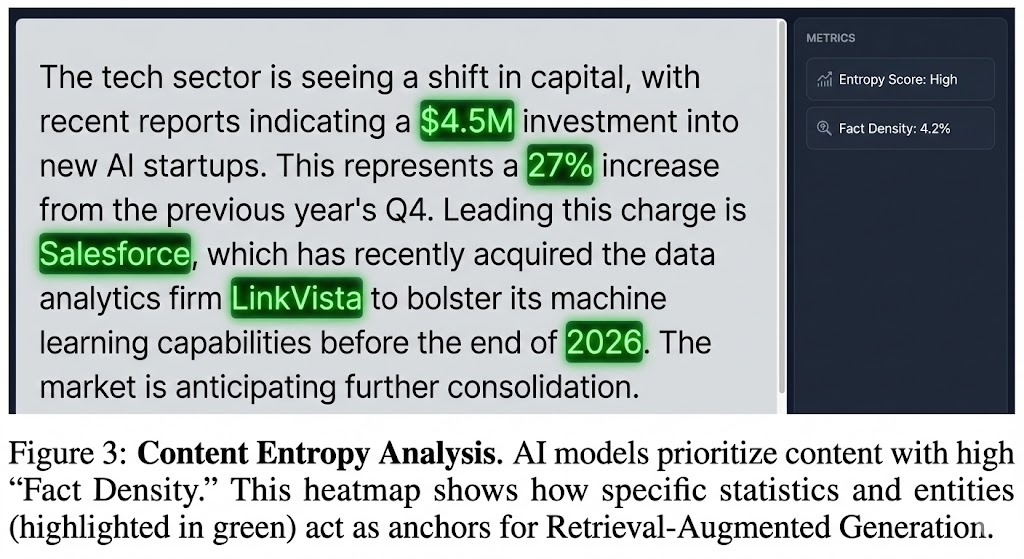
This is the big one. AI models are biased toward “High Entropy” content—content that introduces new information rapidly.
- The Strategy: Fluff is your enemy. “Fact Density” means including a statistic, a unique data point, or a specific figure every 150 words. Don’t say “Sales grew significantly.” Say “Sales grew by 527% in Q3.” The AI clings to specific numbers like a lifeline because they are verifiable.
Why AI Loves Listicles (And You Should Too)
For years, high-brow writers rolled their eyes at listicles (“Top 10 Ways to…”). Well, joke’s on them. Lists are the native language of AI.
Token Efficiency: Speaking the Robot’s Language
AI processes information in “tokens.” A wall of text is hard to parse; it requires a lot of computational power to figure out what matters. A list with clear <h3> headers and bullet points is pre-structured data.
It tells the AI: “Here is a discrete set of facts.” This reduces the “cognitive load” on the engine, making it much more likely that the AI will pull your list and serve it to the user. At LinkVista, we advise clients to move away from dense whitepapers and toward “Modular Content”—listicles, data tables, and direct answers.
The B2B Revolution: Winning the “Invisible Funnel”
If you are in B2B, GEO is critical. Your buyers are already using AI to research vendors.
Imagine a CEO asks an AI: “Compare Salesforce, HubSpot, and Microsoft Dynamics for a mid-sized firm.”
The AI generates a comparison table. If your brand isn’t in that table, you have lost the deal before you even knew it existed. This is the “Invisible Funnel.” Traditional analytics can’t track it, but it drives revenue. By optimizing for GEO, you ensure your brand is recommended by the machine, effectively gaining a neutral, third-party endorsement that decision-makers trust.
Conclusion: Adapt or Disappear
We are standing on the precipice of a new internet. The era of “Blue Links” is setting, and the era of the “Synthesized Answer” is dawning.
For businesses, the choice is binary: adapt to the language of AI or fade into obscurity. SEO gets you found by people looking for a website. GEO gets you cited by machines answering questions. As we move toward 2026, the market will split into those who are cited and those who are invisible.
The time to build your “Citation Moat” is now. Are you ready to stop chasing clicks and start engineering authority?
Frequently Asked Questions (FAQs)
1. Does GEO replace traditional SEO entirely?
Not immediately, but the balance is shifting rapidly. SEO is still useful for navigational queries (e.g., finding a specific login page), but for informational and research-based queries, GEO is taking over. A hybrid approach is currently best, but the future leans heavily toward GEO.
2. Can I do GEO if I’m a small business with no domain authority?
Yes, actually. Because AI prioritizes “Fact Density” and relevance, a small site with highly specific, unique data (like original research or expert quotes) can out-perform a large, generic site. You don’t need to be the biggest; you need to be the most factually dense.
3. How do I measure GEO success if I can’t track clicks?
Success in GEO is measured by “Share of Voice” and “Citation Frequency.” You track how often your brand appears in AI-generated answers for your target questions. Tools are currently being developed to track this “Dark Social” traffic and brand sentiment within LLMs.
4. Why are “unlinked mentions” valuable in GEO?
In traditional SEO, a mention without a link was almost useless. In GEO, LLMs read the text. If your brand is mentioned frequently in positive contexts on forums or news sites, the AI learns to associate your “Entity” with those topics, boosting your authority even without a direct hyperlink.
5. What is the single biggest mistake people make with GEO?
Writing “low-entropy” content. This means writing long, fluffy intros and generic advice that everyone else has already said. AI models ignore repetitive, low-value text. To win at GEO, you must provide new, specific, hard data that the AI hasn’t seen a million times before.